

The best company picnic food is handheld or scoopable, holds up outdoors, covers every dietary need and ends with a dessert people talk about on Monday. Build the savoury side around cold-safe make-ahead dishes, plan portions by headcount, keep perishables under the Health Canada time and temperature limits, and let the dessert be the part guests see and enjoy. For many Ontario workplaces, that dessert is an ice cream truck parked at the picnic, serving soft-serve, sundaes, floats and popsicles to the whole team.
TL;DR
- Choose handheld foods, scoopable salads and make-ahead dishes. Skip anything heavy on mayonnaise or whipped cream that spoils in heat.
- Keep cold food at 4°C or colder and hot food at 60°C or hotter. Perishable food should not sit out more than one hour on a hot day.
- Ask about allergies and dietary needs when you send the invite, not at the picnic.
- Plan roughly 3 oz of protein, a sandwich, salad and vegetables per person from the BC guide, then add a cushion for outdoor appetites.
- Finish with a dessert that needs no kitchen: our ice cream trucks serve the whole team in one line.
Table of Contents
- Start with what a company picnic menu has to do
- Mains that travel and hold up
- How much food per person
- Dietary needs: ask early, label clearly
- Keep it safe: the Canadian rules that matter
- Pack the practical extras
- The dessert that needs no cooler
- A sample menu for 40 people
- Book the dessert for your company picnic
- FAQ
- Sources
Start with what a company picnic menu has to do
A picnic at work is not a family picnic scaled up. You are feeding people who have different diets, different schedules and, often, a few severe allergies, and you are doing it outdoors where food safety margins shrink.
A good menu does four things:
- It can be eaten standing up, with one hand, while talking to a colleague.
- It survives an hour or two outside without turning into a risk.
- It gives each dietary group a real meal, not a side dish.
- It needs very little work on the day, so the organizer can enjoy the event too.
One official voice worth hearing: a Government of Manitoba nutrition analyst, quoted in BC’s Eat Smart Meet Smart guide, suggests that when food is served at work it should show what real food looks like rather than defaulting to donuts and soft drinks. That is a useful test for the main menu. Dessert, then, can be a deliberate treat rather than the default.
Mains that travel and hold up
Handheld and scoopable wins
CBC Life’s picnic potluck guide recommends handheld foods such as sausage rolls, or scoopable salads, and advises against dishes with a lot of mayonnaise or whipped cream that spoil in the heat. Wraps, sandwiches, skewers, kimbap, grain salads and pasta salads with an oil-based dressing all fit.
Make-ahead dishes that improve overnight
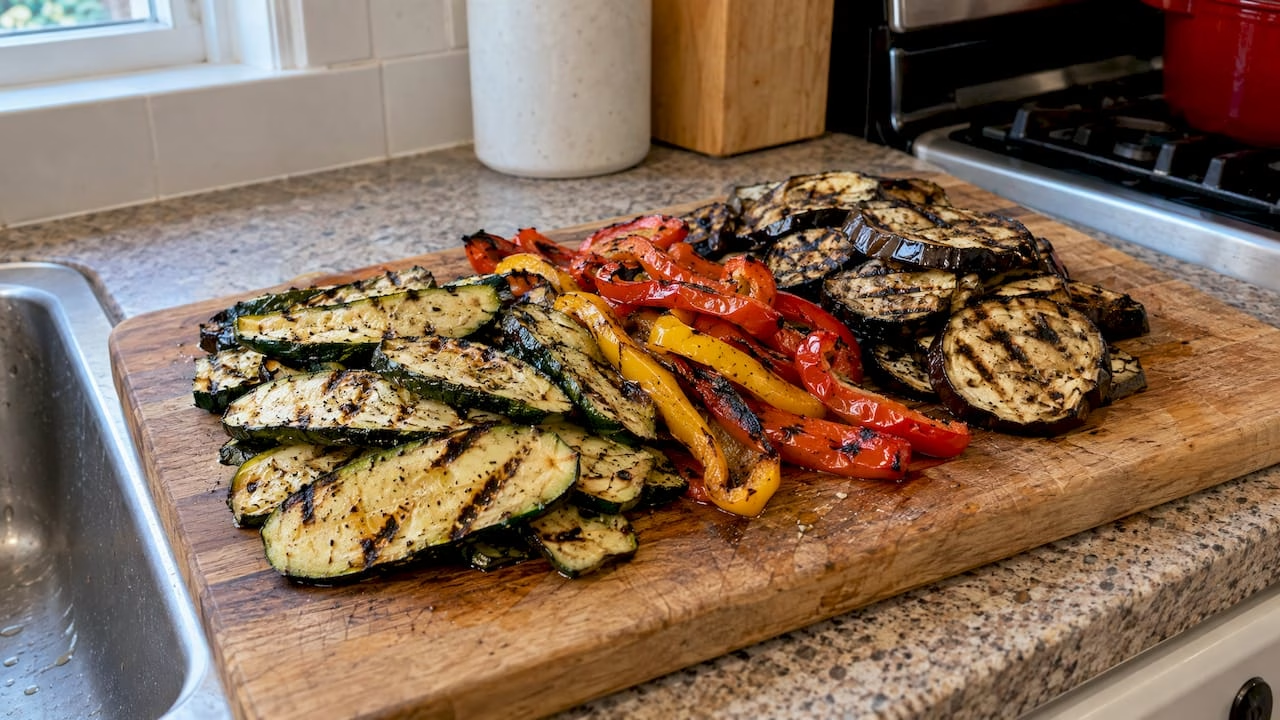
Some dishes are better after a night in the fridge. Serious Eats lists lemony couscous salad (good for up to 24 hours), lemony orzo pasta salad, kimbap, muffuletta and pan bagnat sandwiches, and grilled vegetable boards that can be grilled the day before.
For a vegetarian option, Health Canada’s chickpea and carrot salad is a no-cook recipe that keeps in the fridge up to one day. Pack the dressing separately and mix it just before serving so the salad stays crisp.
Two mains are enough
A common mistake is offering five proteins. A Toronto catering guide from LunchLink advises two complementary mains, for example a chicken or beef option plus a substantial vegetarian or vegan one. Guests get real choice, and nobody is staring at a confusing buffet.
Should you grill?
Grilling together can be part of the fun. CBC Life notes that some parks allow portable grills or have reservable grills and fire pits. Check with the park first. If you grill, Health Canada’s summer food safety advice is to cook raw meat, poultry and seafood to safe internal temperatures and check them with a digital food thermometer. Keep raw meat at the bottom of the cooler in sealed containers.
How much food per person
The BC guide gives practical per-person amounts for work events: about 3 oz (100 g) of meat, fish or poultry, 1 cup (250 mL) of mixed greens, ½ cup (125 mL) of cooked vegetables and one whole grain sandwich. It suggests drinks in 250 mL sizes at most, and recommends reusable plates, cups and utensils with cloth napkins.
Outdoor appetites run higher than office ones, so round up. A simple method:
| Headcount | What to do |
|---|---|
| Under 25 | Work out the BC per-person amounts, then add one extra main and one extra side. |
| 25 to 75 | Add about 10 to 15% to every category, and add more cold drinks than you think you need. |
| 75 and up | Split food into two serving points so the line never exceeds a few minutes. |
These percentages are our planning rule of thumb, not an official standard. Shorter lines also mean food spends less time sitting in the open.
Salads first, desserts in small portions
Alberta Health Services’ healthy potluck tips suggest placing salads, fruit and vegetables at the start of the food line so people are more likely to take them, and offering desserts in smaller portions so everyone can sample a range of treats. Both ideas suit a picnic: guests fill up on the good stuff first and still have room to try dessert.
Dietary needs: ask early, label clearly
The cheapest way to avoid an awkward moment is to ask before the day. Alberta Health Services advises asking invitees to share diet concerns or food allergies when you send the invite, then following up so the sign-up sheet reflects any ingredient changes. LunchLink makes the same point: collect requirements at RSVP time, separate preferences from allergies, and give vegan guests a filling main rather than only salad and bread.
A dietary restrictions list for events is a handy way to see which requirements to track when you collect RSVPs.
Practical rules for the day:
- Label every dish in plain language with its name and, where accurate, tags such as vegan, vegetarian, halal or gluten-free. Call out allergens in readable text.
- Use separate serving utensils for dishes that must stay distinct.
- Keep a list of staff allergies. The BC guide recommends a file of allergies and asking for emergency treatment plans for employees with severe allergies. Tell the person running the picnic where that list is.
- Keep the dessert inclusive. Organic and kosher options matter at a mixed workplace, and a menu with several flavours and toppings lets more people take part.
People with a severe food allergy should confirm ingredients directly with whoever prepared or supplied each item, and follow their own doctor’s emergency plan.
Keep it safe: the Canadian rules that matter
Warm weather and long tables are where picnics go wrong. The numbers below come from Canadian health authorities.
| Rule | Figure | Source |
|---|---|---|
| Danger zone for bacteria growth | 4°C to 60°C | Health Canada |
| Perishable food at room temperature on a hot day | No more than 1 hour | Health Canada |
| Cooler temperature | 4°C or below, with ice packs, out of direct sun | Health Canada |
| Cooking and reheating temperature | 74°C | Northern Health |
| Hot food holding | 60°C or warmer | BC guide |
| Leftover cooling | Shallow containers, chilled quickly | Health Canada |
A few habits make these numbers easy to follow:
- Use two coolers, one for food and one for drinks, since the drinks cooler gets opened constantly. Health Canada recommends separate coolers.
- Nest cold dishes in bowls of ice and keep hot dishes in chafing dishes or slow cookers, as the BC guide suggests. Alberta’s special events package notes that open-flame chafing dishes are not recommended outdoors.
- Serve within 30 minutes of delivery if food is brought in, per the BC guide.
- Throw out perishable food that has sat out too long. Manitoba’s food-safety manual says food should not stay in the 4°C to 60°C range for over two hours, or one hour when the room is above 35°C. Northern Health says to discard food left out more than 2 hours. On a hot day, use the shorter limit.
- Pre-portion salads into sealed cups if your group is large, so nobody dips a spoon into a bowl that has sat in the sun.
If your picnic is open to the public or advertised, you may need a temporary food permit. Northern Health notes that advertised or public events require one in its region, so check with your local public health unit. Ontario organizers should ask their local health unit about its own rules. If a catering team is serving, ask them which permits they hold. For larger events, Manitoba recommends at least one person with a Food Safe certificate for group catering.
Pack the practical extras
- Reusable plates, cups and utensils. CBC Life suggests asking guests to bring their own to cut waste.
- A digital food thermometer, which Health Canada recommends for anything cooked.
- Wind-proof, printed labels. A taped card holds up better than a menu on a stand.
- Plenty of water. Let people who cannot cook still contribute, as Alberta Health Services suggests, by setting up the eating area, filling water jugs, making coffee or handling clean-up.
If everyone is bringing a dish, a shared sign-up spreadsheet with themes helps. CBC Life recommends one to balance drinks, appetizers, mains, sides and desserts, so you do not end up with eleven bags of chips.
The dessert that needs no cooler
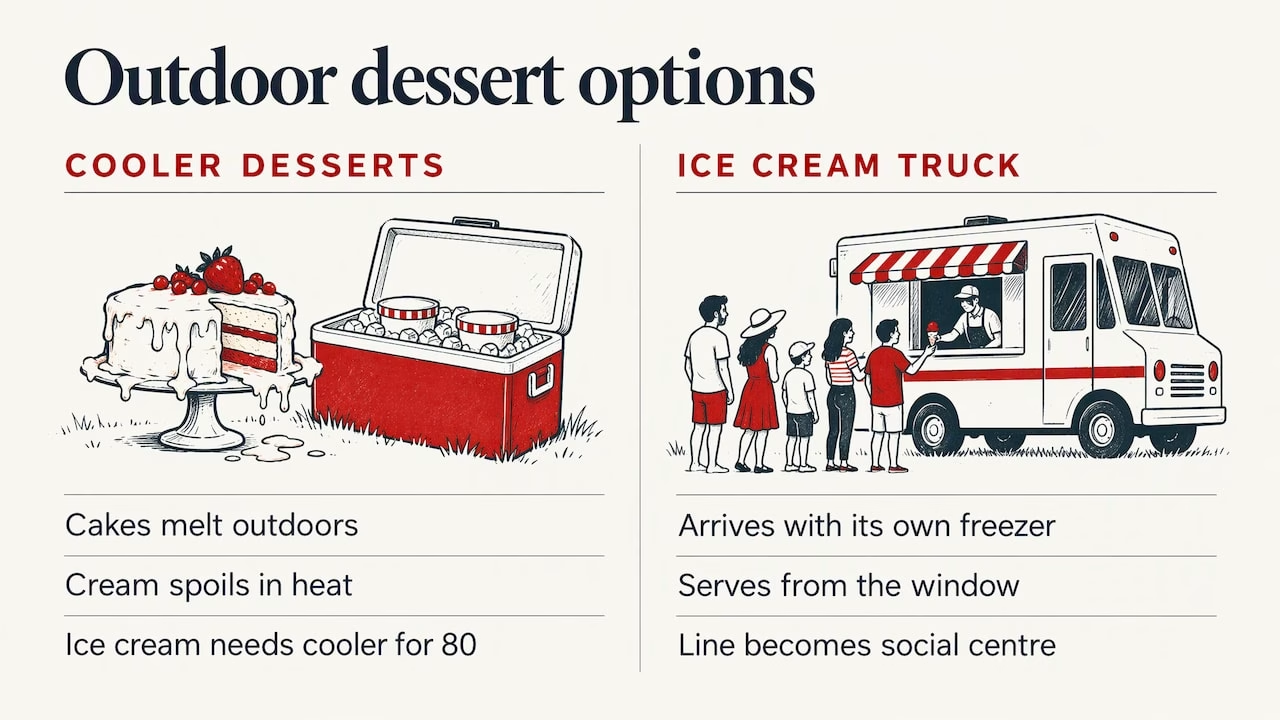
Dessert is the hardest course to do outdoors. Cakes melt and cream spoils, and carrying a cooler of ice cream for 80 people is not realistic.
An ice cream truck solves that. It arrives with its own freezer and serves from the window, so there is no scooping at the picnic table, no melting tubs and no extra work for the organizer. For a workplace picnic, we offer soft-serve, sundaes, floats, milkshakes, popsicles and banana boats with customizable toppings, including organic and kosher options. Packages are customizable, and trucks can carry your branding, so a company picnic can have its own look.
It also changes the shape of the afternoon. Instead of everyone eating at the same moment and then drifting back to their desks, the line at the truck becomes the social centre of the event.
If you are planning more than a picnic, our guides on outdoor party food that holds up in the heat, office treat ideas and dessert catering packages cover the details.
A sample menu for 40 people
Here is a menu that follows everything above. Adjust it to your RSVP list.
| Course | Dish | Why it works |
|---|---|---|
| Main 1 | Chicken or beef wraps, pre-wrapped | Handheld, kept in a cooler until service |
| Main 2 | Chickpea and carrot salad with grain, dressing packed separately | Vegetarian and vegan main, keeps one day |
| Sides | Orzo salad with oil dressing, grilled vegetable board, fruit | No mayonnaise, make-ahead |
| Drinks | Water, iced tea, lemonade in 250 mL cups | Easy to portion |
| Dessert | Ice cream truck with soft-serve and toppings | No kitchen, no cooler, one line |
Set out salads and fruit first, label everything, and keep the cold items in the shade until the line opens.
What we think about picnic food
A picnic menu is judged by the last thing people eat. Everything before it is about safety and ease, and the finish is about the memory. We built our trucks around that idea: at an event, a line of colleagues choosing a sundae, a float or a popsicle turns an ordinary lunch into something people mention afterwards.
We also know the work behind a company picnic falls on one or two people. That is why we offer customizable packages, a wide menu with organic and kosher options, and branding for corporate events. The organizer’s job is the menu and the schedule. The dessert should not add to it.
the author
Book the dessert for your company picnic
Our ice cream truck rentals for corporate events serve company picnics, office celebrations and team days across Ontario. Pick a package, choose your flavours and toppings, including organic and kosher options, and add your branding if you like.

If you are comparing formats, see our corporate ice cream catering page or start at Classic Cone ice cream truck rentals to request a booking.
FAQ
What food should I avoid at a company picnic?
Avoid dishes heavy in mayonnaise or whipped cream, since CBC Life notes these spoil in the heat. Also avoid anything that cannot be kept at 4°C or below or 60°C or above. If a dish cannot be kept cold or hot, do not serve it.
How long can picnic food sit out?
Health Canada says perishable food should not be left at room temperature for more than one hour on hot summer days. Other provincial guides allow up to two hours in cooler conditions. When in doubt, use the shorter limit and discard what has sat longer.
How do I handle dietary restrictions?
Ask when you send the invitation and follow up on the sign-up sheet, as Alberta Health Services advises. Label each dish, use separate serving utensils and give vegetarian and vegan guests a real main. Keep a list of severe allergies on hand for the day.
How much food do I need per person?
The BC guide suggests about 3 oz of protein, a cup of greens, half a cup of cooked vegetables and a sandwich per person. For an outdoor event, add a cushion on top of that and plan extra cold drinks.
Can an ice cream truck serve a whole office?
Yes, a truck is built to serve a line of guests from its window, with soft-serve, sundaes, floats, milkshakes and popsicles on the menu. Tell us your headcount and schedule when you request a booking and we will build the package around your event.
Sources
- CBC Life: 23 crowd-pleasing recipes for your next picnic potluck
- Serious Eats: 17 easy make-ahead dishes for stress-free summer picnics
- Health Canada: Chickpea and carrot salad
- Health Canada: Summer food safety tips
- Alberta Health Services: Healthy Potlucks, Tips for Hosting
- Northern Health: Safe foods for potlucks
- Government of Manitoba: Connection food safety manual
- Alberta Health Services: Special Events Food Vendor Package
- LunchLink: Backyard BBQ catering for 30 guests in Toronto
- Dietary restrictions list for events