
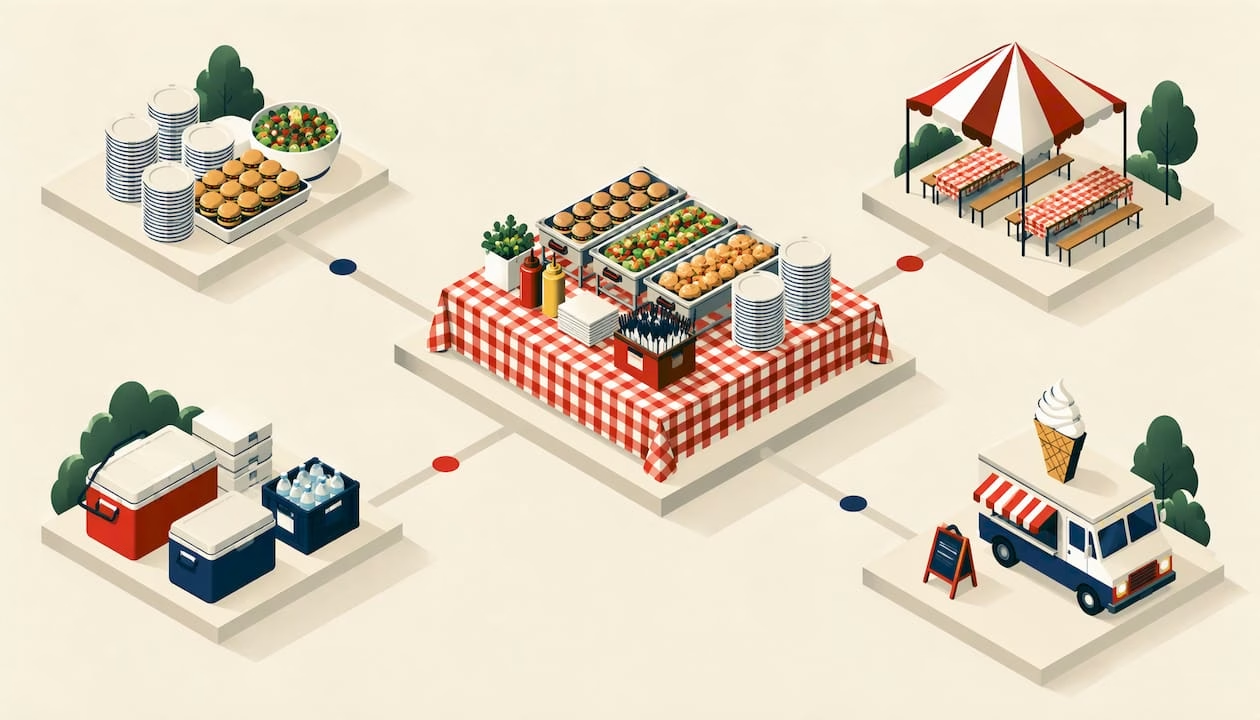
Feeding 30, 60 or 150 people comes down to three decisions: a menu that scales, quantities that avoid both shortages and mountains of leftovers, and a way to keep everything at a safe temperature while guests eat. The dessert is the part most hosts leave for last, and it is the easiest to hand off. At Classic Cone, we bring the ice cream truck to birthdays, weddings, school events and office parties across Ontario, so the sweet course is served fresh, to order, while you focus on the main meal.
This guide covers the whole plan, from what to cook to how much to buy to how to serve it, for families, workplaces, schools and couples.
TL;DR
- Pick dishes that scale, travel and reheat well: pasta bakes, chili, pulled pork, sliders, big salads and build-your-own bars.
- Plan roughly 100 g (3 oz) of meat, fish or poultry per person for a meal, then adjust for the crowd and the time of day.
- Keep hot food at 60°C or above, cold food at 4°C or below, and never leave perishables out longer than two hours.
- Offer at least one dish that works for vegetarian, dairy-free and gluten-free guests, and ask about allergies before you shop.
- Let dessert serve itself: an ice cream truck gives every guest a treat without adding a single dish to your prep list.
Table of Contents
- Start with the crowd, not the recipe
- Dishes that work for large groups
- How much food to plan per person
- Serving food safely to a crowd
- Feeding guests with different dietary needs
- Why dessert is the easiest course to hand off
- A sample plan for 40 guests
- Questions to settle before you book anything
- Our view: let the main meal be simple and the dessert be an event
- Book the truck, skip the dessert prep
- FAQ
- Sources
Start with the crowd, not the recipe
The best large-group menu is the one that matches who is coming. Before choosing dishes, write down four things: the headcount, the share of children, the time of day, and whether people will sit or stand with a plate in hand.
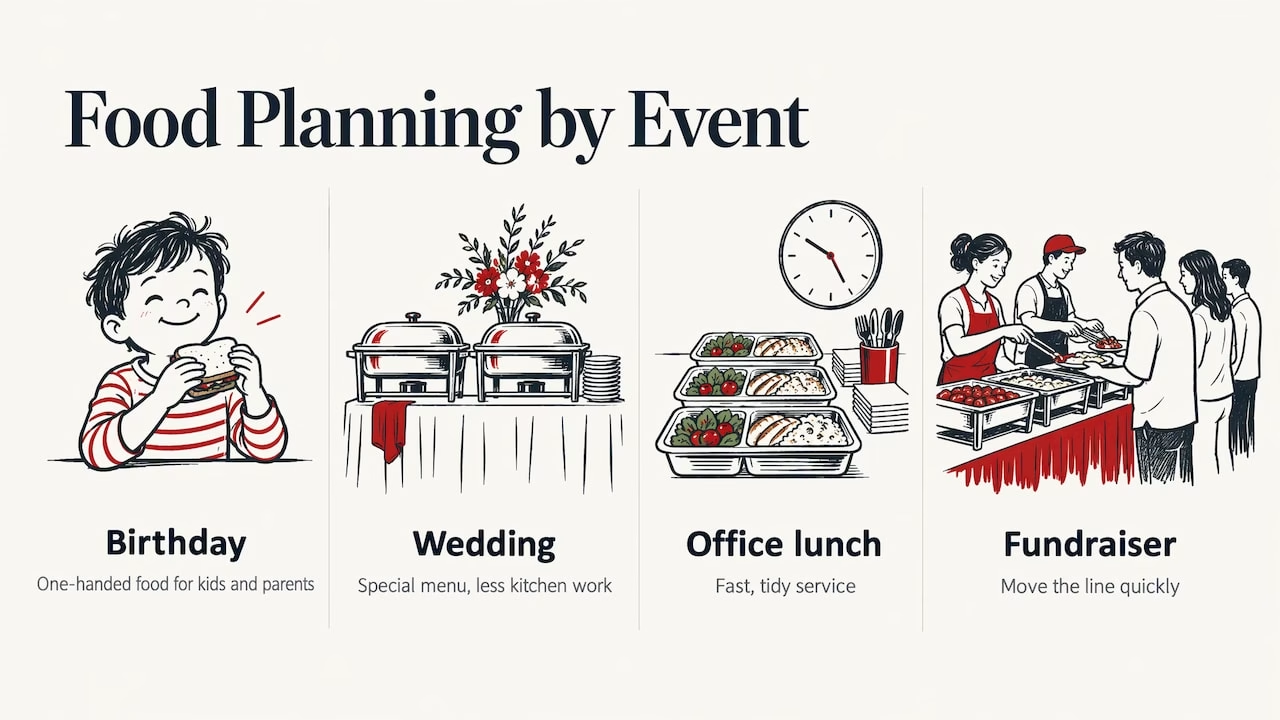
A birthday party with 25 kids and 15 parents wants food that is easy to eat with one hand. A wedding reception wants a menu that feels special without keeping the couple in the kitchen. An office lunch needs to be fast and tidy. A school fundraiser needs to move a line of people quickly. The same chili could suit three of those and fail at the fourth.
Also decide how much you want to cook yourself. Some hosts enjoy a day of batch cooking. Others want to hand off as much as possible. Both are valid, and the plan below works for either: choose a few anchor dishes, fill gaps with easy sides, and give dessert its own station.
Dishes that work for large groups
The formula that shows up again and again in crowd-feeding collections is simple. Choose food that is cooked in one big pot or pan, holds well, and is familiar enough that nobody feels they are being tested.
Mains that scale
Taste of Home’s collection of 47 dinners that feed a crowd leans on dependable classics: meatloaf, tacos, chicken pot pie, barbecued meats, big pots of soup, pasta, and 13×9 pan dinners that are easy to double or triple. That tells you what works: dishes where doubling the recipe means a bigger pan, not twice the effort.
For a Canadian crowd, good anchors include:
- Baked ziti or lasagna: assemble the day before, bake on the day.
- Pulled pork or chicken in a slow cooker: serve with buns and slaw.
- Chili: one big pot, with toppings on the side.
- Sliders or small sandwiches: easy for kids and adults to grab.
- Macaroni and cheese with vegetables: Health Canada’s Food Guide kitchen lists a version, alongside turkey chili and braised lentils with greens, with filters for “30 minutes or less” and “freezer-friendly.”
Make-ahead sides
Sides are where a large-group menu is won. Pasta salads, slaws, baked beans and roasted vegetables can all be made the day before. CBC Life’s potluck guide, published in October 2025, suggests dishes such as spanakopita and slow cooker scalloped potatoes, and notes that the frozen-phyllo spanakopita can be prepared a day ahead. The same piece advises hosts to give clear details in the invite, including headcount, timing and format, and to assign guests a category such as sides, so you do not end up with six desserts and no vegetables.
Build-your-own formats
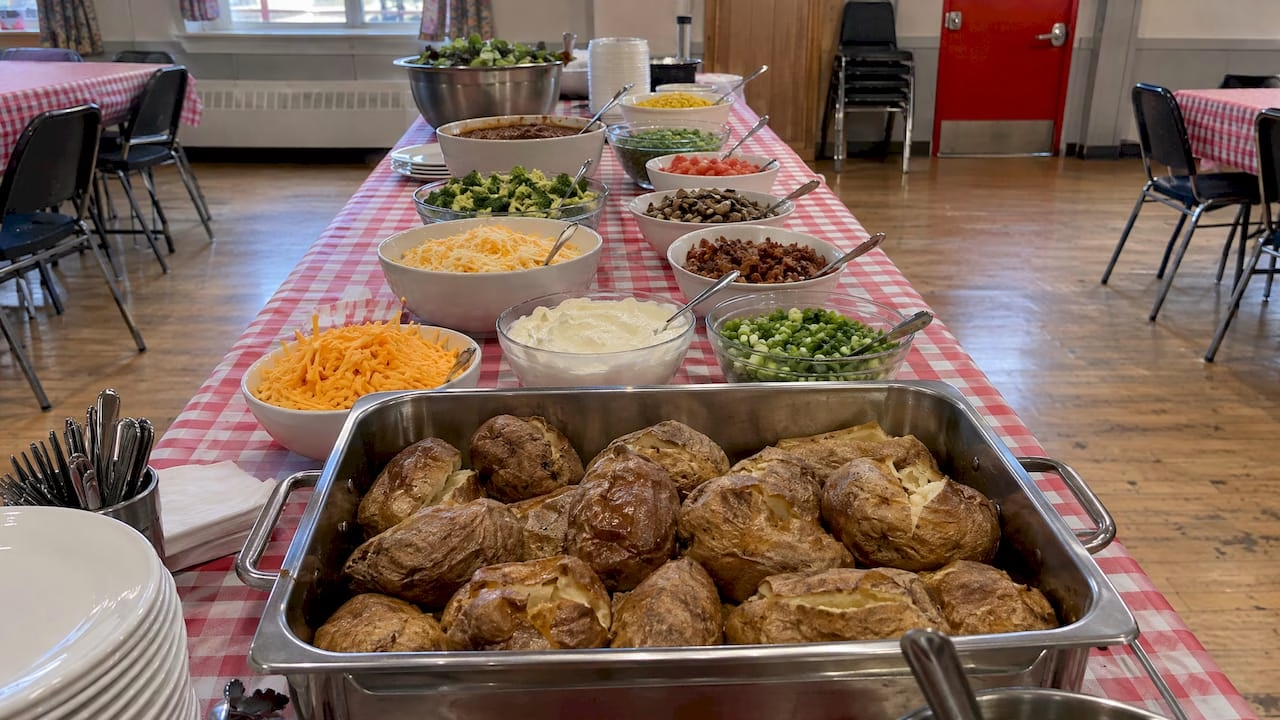
A taco bar, baked potato bar or grain-bowl line lets guests assemble exactly what they want. Camille Styles calls these formats heroes for large groups: you prepare the components, guests build their plates, and dairy-free, gluten-free, vegetarian and vegan eaters can all find something without a separate menu. It also gives you natural conversation at the table, which matters at weddings and family reunions.
How much food to plan per person
Most hosts over-buy for fear of running out. A useful anchor comes from British Columbia’s government guide, Eat Smart Meet Smart, which suggests per-person portions for events: about 100 g (3 oz) of meat, fish or poultry, 1 cup (250 mL) of mixed greens, ½ cup (125 mL) of cooked pasta or brown rice, and one sandwich or half a wrap.
Use those as a baseline, then adjust:
| Situation | Adjustment |
|---|---|
| Mostly adults, dinner time | Move toward the high end of the main portion |
| Mixed adults and kids | Children eat less, so a mixed crowd usually needs less than a headcount suggests |
| Light afternoon event | Lean on sandwiches, wraps and salads, with smaller mains |
| Several mains on the table | Reduce each one, since guests sample across dishes |
If you are scaling a recipe, do not multiply blindly. Mel’s Kitchen Cafe, a long-running home cooking site, points out that side dishes tend to stretch further in a big group than the stated serving size suggests, so a recipe for six often feeds more than six when 15 to 20 people are sharing several dishes. Scaling a six-serving recipe by a little under the full multiple is a common way to avoid heavy leftovers.
A worked example: 40 guests at a summer birthday, 25 adults and 15 children. Count the children as roughly half portions, which gives about 32 adult-equivalents. At 100 g of protein each, that is about 3.2 kg (7 lb) of cooked meat before you add a bit of margin. Pair it with two salads, one hot side and rolls, and you are covered.
Serving food safely to a crowd
A large group is where food safety slips, because food sits out longer and more people eat it. The rules are short and worth memorizing.
- The temperature zone: Health Canada says cold foods stay at or below 4°C and hot foods at or above 60°C. The range between is the danger zone for bacterial growth, and perishable food left at room temperature for more than two hours should be thrown out.
- Hot food: keep it in chafing dishes, slow cookers or warming trays, not on the counter. The BC event guide recommends serving food within 30 minutes of delivery and holding hot dishes at 60°C or above.
- Cold food: nest salads and cold platters in ice. Check them as the afternoon warms up.
- Hot days: Manitoba’s community food safety manual, Connection, shortens the limit to one hour when the room temperature is above 35°C. The same manual covers fall suppers, weddings, family reunions and fundraisers, and recommends having thermometers and shallow containers on hand.
- Leftovers: the Public Health Agency of Canada advises refrigerating or freezing perishable food within two hours of cooking and reheating leftovers until steaming hot.
If you are running a public event, such as a school fundraiser or community supper, rules about notifying your local public health unit can apply, and they differ by province and municipality. Contact your local public health unit in Ontario before the event to confirm what applies to your food service.
Feeding guests with different dietary needs
With 50 people, someone will have an allergy, a religious dietary requirement or a preference. Plan for it early instead of scrambling on the day.
Health Canada’s educator toolkit recommends keeping a written list of the group’s dietary restrictions and speaking with parents or guardians about children’s allergies. It also reminds cooks to wash hands for at least 20 seconds and use separate cutting boards for produce and raw meat. Add a line to your invitation or registration form asking about allergies, and label every dish.
The easiest approach is to design around inclusion: one main that is vegetarian, a salad that is dairy-free, and a bread or starch option that is gluten-free. Build-your-own bars make this almost automatic.
Dessert is where dietary needs often get overlooked, and where we can help. Our menu includes organic and kosher options along with customizable toppings, so more guests can join the same treat line.
Why dessert is the easiest course to hand off
Every dish you make yourself needs shopping, prep, cooking, holding and serving. Dessert is the last course, when the host is most tired and the kitchen is most crowded. Cakes need cutting, plates need washing, and ice cream scooped in the kitchen melts while you wait for everyone to be ready.
An ice cream truck removes the whole course from your list. Guests walk up, choose what they want, and take it away, so no one waits for a plate to be passed. Our menu covers soft-serve ice cream, sundaes, floats, milkshakes, popsicles and banana boats, with customizable toppings, so adults and children both find something to order. For ideas on how this fits an outdoor menu, see our guide to outdoor party food that holds up in the heat.
Birthday parties
For a child’s party, keep the main meal simple: pizza, sliders or a pasta tray, with fruit and veggies on the side. Then let the truck be the highlight. Our birthday party ice cream trucks let the guest of honour feel like the star, and you can read how booking works in our guide to an ice cream truck for a birthday party in Ontario. If you want guests to leave with something lasting, non-candy party favors for kids keep the sugar on the truck and the keepsake in the loot bag.
Weddings
A reception menu can be plated, family-style or served from stations. Whatever you choose, an ice cream truck gives guests an informal moment between the formal courses, and it is something they remember. See our wedding ice cream truck catering for how couples use it, or the wedding truck rentals page to get started.
Office parties and corporate events
For a team lunch, sandwich trays and salads are fast and tidy. The treat at the end is what people talk about on Monday. Our corporate ice cream catering page explains the format, and our guide to organizing a corporate ice cream social walks through the planning. Trucks can also carry your company branding, which suits a client appreciation day.
Schools and fundraisers
Schools feeding hundreds need food that moves fast. Pair a simple lunch or barbecue with a truck, and the treat line becomes part of the event. For fundraisers, see our school fundraiser ice cream truck ideas and our fundraiser truck rentals.
A sample plan for 40 guests
Here is how the pieces fit for a summer afternoon party with 25 adults and 15 children:
- Two days before: confirm headcount and collect allergy information. Book the truck.
- The day before: make pasta salad, slaw and baked ziti. Chill everything. Prepare toppings for the build-your-own station.
- Morning of: set up chafing dishes, ice trays and thermometers. Label dishes.
- Serving time: put out hot food, keep cold dishes nested in ice, and start the clock for the two-hour limit.
- Dessert: the truck arrives and guests line up when they are ready. No cutting, scooping or plating.
- Cleanup: refrigerate leftovers within two hours, or sooner on a hot day.
Questions to settle before you book anything
- How many guests, and how many are children?
- Is the event indoors or outdoors, and how hot will it be?
- Who has allergies or religious dietary requirements?
- Do you have hot and cold holding equipment, or will the menu avoid needing it?
- Where will the truck park, and where will guests line up?
Answering these first makes every later decision easier, from the menu to the booking.
Our view: let the main meal be simple and the dessert be an event
Most large-group hosts spend their energy on the wrong course. The main meal is where people eat to be full, and familiar food does that job well. Dessert is where people remember the occasion.
We built Classic Cone as a family-owned business for events of all sizes across Ontario, and we see dessert as the part of the menu that gives guests something to do, not just something to eat. A line at the truck gets people talking, laughing and choosing for themselves.
That is why we offer a wide range of flavours and toppings, from classic vanilla and chocolate to modern twists, with organic and kosher options and customizable packages. Your guest list is not one-size-fits-all, and neither is a dessert menu.
Keep dinner simple, and give the sweet moment to us.
the author
Book the truck, skip the dessert prep
If you are planning a birthday, wedding, office event, school day or fundraiser in Ontario, our ice cream truck rentals cover the dessert for your whole group. Choose from soft-serve, sundaes, floats, milkshakes, popsicles and banana boats, add customizable toppings, and shape the package around your event.
Start on our ice cream truck rentals page to tell us about your event.
FAQ
What is good to cook for a large group?
Choose dishes that scale and hold well: baked pasta, chili, pulled pork, sliders, big salads and sheet-pan meals. Pair them with make-ahead sides and a build-your-own element so guests with different tastes can each assemble a plate they like.
How much food do I need per person?
A good starting point is about 100 g (3 oz) of meat, fish or poultry per person, plus about a cup of salad and half a cup of pasta or rice, based on BC’s event guide. Children eat less, and guests eat less of each dish when there are several, so adjust down for mixed crowds.
How long can food sit out at a party?
Perishable food should not sit at room temperature for more than two hours, according to Health Canada. Hold hot food at 60°C or above and cold food at 4°C or below. On a very hot day, shorten the window to one hour.
What is the 2-2-2 rule for food?
It is a leftovers guideline: refrigerate cooked food within two hours, eat refrigerated leftovers within about two days, and freeze them for up to two months for best quality. The Public Health Agency of Canada’s own advice is to refrigerate or freeze within two hours and use or freeze leftovers within four days.
How do I handle dessert for a big crowd?
Offer one dessert that guests serve themselves instead of cutting a cake and plating portions. An ice cream truck from Classic Cone does this for birthdays, weddings, school events and corporate parties across Ontario.
Sources
- Food guide kitchen, Canada.ca
- 47 Dinner Recipes That Will Feed a Crowd, Taste of Home
- Potluck season is back, CBC Life
- 23 Inexpensive Meals for Large Groups, Camille Styles
- How and What to Feed a Crowd, Mel’s Kitchen Cafe
- Holiday food safety, Canada.ca
- Connection food safety manual, Government of Manitoba
- General Food Safety Tips, Canada.ca
- Food safety considerations, Canada’s food guide toolkit