

Good graduation party catering comes down to four decisions: the format, the quantity, the dietary plan and the dessert. Get those right and the day runs itself. For the dessert, the easiest way to give guests something they will talk about is to bring the dessert to them: a soft-serve truck parked at the party, which is what we do at Classic Cone across Ontario.
This guide is for families planning a grad party, and it also applies to schools hosting a class celebration and to companies marking a graduating cohort. It covers what to serve, how much, how to handle allergies and where ice cream fits.
TL;DR
- Pick one clear food format (buffet, stations or finger food) instead of many unrelated dishes, and match its formality to the ceremony.
- Plan roughly 1 to 1.5 pounds of food per guest, and base the count on about 60% of the people you invite, since open houses have uncertain turnout.
- Collect dietary needs on the RSVP and label every dish; severe allergies need separate prep.
- Keep perishable food out of the 40°F to 140°F (4°C to 60°C) danger zone for no more than two hours.
- Finish with a dessert guests can customize: a soft-serve ice cream truck handles the sweet course without taking over your kitchen.
Table of Contents
- Start with the kind of party you are hosting
- Choose a catering format
- How much food per guest
- Keep food safe for the whole afternoon
- Plan for dietary needs and allergies
- What graduation catering costs
- Setup, serving and cleanup
- Make dessert the memory
- Perspective
- Book the dessert for your graduation
- A simple timeline
- FAQ
- Sources
Start with the kind of party you are hosting
A graduation party is rarely a sit-down dinner. Most are open houses where guests trickle in over three to five hours and stay for 30 to 60 minutes, according to a US food blogger who has hosted many. That changes how you cater. You are feeding a stream of people, not a table of 50 who all sit down at 6 p.m.
Three questions set everything else:
- What time is it? A noon party is essentially lunch. A 3 p.m. party lands between meals, so lighter food works. An evening party means many guests have already eaten dinner.
- How formal was the ceremony? A high school backyard open house suits casual food. A college or graduate reception can handle a more refined spread.
- Where is it? A backyard, a rented hall, a school gym and a park each have different kitchen, power and parking limits, and those limits decide what a caterer can bring.
Write the answers down before you call anyone. Every caterer will ask them, and quotes you gather will be easier to compare.
Choose a catering format
Catering is sold in a handful of service styles. A Canadian event-planning guide lays out five common ones with their timing and staffing:
| Format | How it works | What to know |
|---|---|---|
| Plated | Servers bring each course to seated guests | About 20 to 25 minutes per course for 200 guests; roughly one server per two tables of 10 |
| Family style | Shared platters on each table | Platters land in about 10 minutes for dinners under 150 |
| Buffet | Guests serve themselves | A double-sided line for 300 clears in about 35 minutes; needs about 20% more floor space than plated |
| Stations | Themed food points, often with a chef | Needs a chef per station; budget 1.3 times a plated portion because guests eat more |
| Cocktail or pass-around | Bite-sized pieces served through the room | 8 to 12 one-bite pieces per person for a two-hour reception; one server per 25 to 30 guests |
For a standing, mingling grad party, buffet, stations and finger food are the natural fits. Plated service suits a formal dinner after a college or professional graduation, but it is rarely what a family open house needs.
One identity beats a long menu
A US party-supply guide makes a point worth borrowing: the strongest graduation menus have one clear identity rather than unrelated dishes. Pick a central format, add complementary sides, and tie the presentation to the graduate’s school colours or next chapter. Because guests are standing and talking, it also notes that interactive stations, lighter foods and small portions work especially well.
Some combinations that follow that logic:
- Casual backyard open house: a barbecue with pulled pork or grilled chicken sliders, a fresh salad, pasta salad, baked beans, fruit and a dessert bar.
- Teens and friends: a build-your-own taco or nacho bar, with a clearly separate plant-based filling.
- College or advanced-degree reception: a grazing display with a separate gluten-free section, or a global station with one base, one or two proteins and several toppings.
In each case, the dessert can follow the same logic: one central format, with toppings that let guests make it their own.
How much food per guest
The most useful number comes from university extension specialists: plan 1 to 1.5 pounds of food per guest for a graduation party. The same source breaks it down per person:
| Item | Per guest |
|---|---|
| Protein | 6 to 8 oz (sliders 1.5 to 2, sandwiches 3 to 4, burgers 4 to 6 oz, 2 to 3 meatballs) |
| Sides | 4 to 6 oz |
| Appetizers | 4 to 7 bite-sized pieces |
| Drinks | 2 bottles of water per hour plus 2 cans of soda per hour, or 6 oz of punch |
| Dessert | 1 slice of cake, 1 cupcake or donut, or 1 to 2 cookies or bars |
For 50 guests, that works out to 10 to 12.5 lbs of raw meat for sliders, 2.5 gallons of baked beans and a half sheet cake serving 24 to 50.
Count heads the way open houses behave
Because attendance at an open house is uncertain, a common strategy is to plan for 60% of the people you invite. Another guide suggests assuming 70 to 80% will attend, plus a 10% food buffer. A sensible way to use both: start at 60% for a large, loosely invited party and lean toward 80% when you have a firm RSVP list.
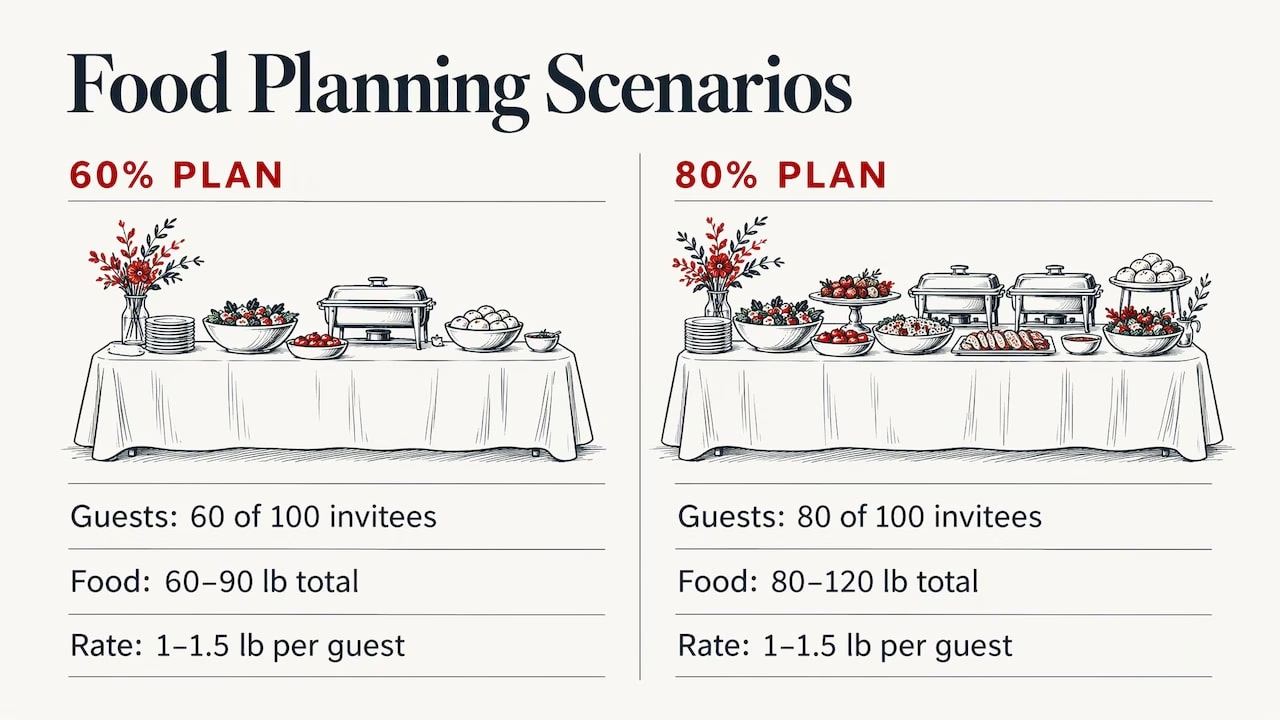
A worked example: you invite 100 people and expect a mix of family and friends. At 60%, you are feeding about 60 guests. At 1 to 1.5 pounds each, that is 60 to 90 pounds of food in total, across proteins, sides and appetizers. If your RSVPs come back strong, move to 80 guests and 80 to 120 pounds.
Two adjustments from Canadian planners: a young crowd at a late party eats more, and an older crowd at a lunch eats less. A late-night snack such as pizza, poutine or sliders needs only about half a portion per guest because a third of guests have left by then.
Spread the food over time
Since guests arrive in waves, you do not need every dish out at once. Hold some items in the kitchen and bring them out fresh later. That also helps with food safety, which is the next issue.
Keep food safe for the whole afternoon
Perishable food must not sit in the 40°F to 140°F danger zone for more than two hours, or one hour when the temperature is above 90°F, per Iowa State University Extension. In Canadian units, that is roughly 4°C to 60°C, and a hot July or June afternoon makes the one-hour limit the one that matters. A graduation ceremony in late June is exactly when backyard parties run warm.
In practice:
- Serve cold dishes in small bowls over ice and refill from the fridge, rather than putting out one large batch.
- Keep hot dishes hot in chafing dishes or slow cookers, and bring out new trays on a schedule.
- Pick sides that handle warmth well, such as pasta salad with a dressing that keeps at room temperature.
- Note the time each tray goes out so someone can take it away on time.
If you are hiring a caterer, ask how they hold food at your venue and what equipment they bring. A good caterer will have a clear answer.
Plan for dietary needs and allergies
By graduation age, guests range from toddlers to grandparents, and some will have allergies or religious dietary requirements. Handling this early is far easier than improvising on the day.
Canadian guidance suggests a five-step method, summarized from a Canadian planning guide:
- Put tick-boxes on the RSVP: vegetarian, vegan, halal, kosher-style, gluten-free, nut allergy, shellfish allergy, plus a free-text line.
- Share the results with your caterer well ahead; for seated events, give them the seating chart by table 72 hours out.
- Design the base menu to be inclusive, for example a naturally gluten-free main, and a nut-free kitchen if children attend.
- Treat severe allergies as requiring cross-contact checks, separate prep and labelled plates.
- Label every dish and station clearly, including for halal, kosher, Jain vegetarian, no beef and no pork, which are common in the Greater Toronto Area.
Alberta’s health guidance for events adds two practical habits: speak directly with any guest who has a food allergy or celiac disease before instructing the caterer, and clarify what terms like “vegan” mean to the guest. For a person with a severe allergy, that conversation matters more than any label.
For guests with a medical allergy or celiac disease, confirm the details with the guest or their family, and with their doctor when in doubt, before you finalize the menu.
What graduation catering costs
Catering prices vary widely by format, city and guest count, and a quote for 50 people can differ by hundreds of dollars from another for the same party. The quote is shaped mostly by service style: drop-off trays cost less than a buffet with staff, and plated service costs the most. Ask each caterer to list what is included: staff, delivery, rentals, setup, cleanup and any service charge.
A useful habit is to request quotes in writing for the same headcount and the same format, so you are comparing like with like. Caterers also need lead time. A university extension source notes 4 to 8 weeks is typical, and grad season is busy, so book early.
Setup, serving and cleanup
The part most hosts forget to plan is the logistics. Settle these with every vendor in writing:
- Access and space: where vendors park and unload, and how close they can get to the serving area.
- Power and water: whether the venue has outlets and a tap, and who brings extension cords or generators.
- Tables and shade: how many tables the buffet or stations need, and whether the line has shade and room to move.
- Staffing: who serves, who refills, who clears. Buffets and stations need people refilling, or lines stall.
- Cleanup: who takes away waste, whether compost and recycling are separated, and when vendors leave.
Outdoors, give the line room. A double-sided buffet needs about 20% more floor space than plated service, so measure your yard or hall before you decide.
Make dessert the memory
Dessert is where a graduation party can stand out. Cake is expected, but a cake is a single slice, eaten quickly. A dessert guests build themselves gets people talking, lining up with friends and taking photos, which suits a standing, mingling party.

That is why we recommend an ice cream truck for the sweet course. At Classic Cone, our menu covers soft-serve ice cream, sundaes, floats, milkshakes, popsicles and banana boats, with customizable toppings including organic and kosher options. That range matters at a grad party: kids want a sundae, teenagers want a milkshake, and grandparents want a simple cone.
The truck also helps with several things above:
- Timing: guests arrive over several hours, and a truck serves to order across the whole window, instead of everything coming out at once.
- Your kitchen: nothing goes in your oven or freezer, and the dessert does not compete with the main meal for space.
- Dietary needs: kosher toppings and an organic option widen who can join in, which suits the labelling advice above.
- Your theme: we offer customizable rental packages and branding opportunities, so the truck can carry the graduate’s school colours or a class message.
Our dessert catering packages page explains what to book for an event, and our soft-serve catering page shows how the soft-serve service works at gatherings.
Quantities for dessert
If you are serving a truck alongside a meal, count it as the dessert course rather than adding it on top of cake. The extension guidance of one slice of cake, one cupcake or one to two cookies per guest is a good reference for how much dessert people eat after a meal. A truck gives each guest one served item they choose, so a simple plan is one treat per guest, and you can keep a small cake for the photo and the toast.
Perspective
We run ice cream trucks at birthdays, weddings, corporate events, school functions and fundraisers, and a graduation party has a lot in common with all of them. Guests arrive in waves, ages are mixed, and everyone wants something that feels like a celebration.
Our view is that the dessert should be the part of the day guests are invited into, not just handed. When a truck pulls up, guests choose their own flavour and toppings, and that choice is the memory. That is why we put so much into the menu: classic vanilla and chocolate for those who want the familiar, modern twists for those who want something new, and organic and kosher options so more of your guests can enjoy the same treat.
We are a family-owned business, and we care about the community side of events. A graduation is a milestone for a whole family or school, and we like to be part of it. Our advice is to settle the main meal first, then book the dessert early, because grad season is busy.
the author
Book the dessert for your graduation
If you are planning a graduation in Ontario, our ice cream truck rentals cover private parties, school functions and corporate events, with a customizable menu and package for your date and venue. A school marking a graduating class can start from our page on truck rentals for parties, schools and corporate events, and a family can look at our birthday party trucks, which work the same way for any family celebration.

Tell us your date, your guest count and your venue, and we will build the package around them.
A simple timeline
Work backwards from the party date:
- 8 to 12 weeks out: set the date, the venue, the guest list and a rough budget. Book the caterer and the dessert, since grad season fills early.
- 6 to 8 weeks out: send invitations with an RSVP that includes dietary tick-boxes.
- 3 to 4 weeks out: choose your menu, confirm the format and decide how many guests to plan for.
- 1 to 2 weeks out: confirm the final count, send dietary details to every vendor, and check power, parking and tables.
- The day before: confirm arrival times, prepare labels, and set up the cold-storage plan.
- On the day: assign one person to watch the food timing and another to greet vendors, so the host can enjoy the party.
FAQ
How much food do I need for a graduation party?
Plan about 1 to 1.5 pounds of food per guest, covering protein, sides, appetizers and dessert. Because attendance at open houses is uncertain, base the count on about 60% of your invite list, or up to 80% if your RSVPs are firm. Add a small buffer if you want leftovers.
What is the best catering format for a graduation party?
For a standing, mingling party, buffet, food stations or finger food work best because guests can eat when they arrive. Plated service suits a formal seated dinner. Whichever you choose, keep one clear food theme rather than many unrelated dishes.
How far ahead should I book graduation catering?
Caterers typically need about 4 to 8 weeks, and graduation season is busy, so earlier is safer. Book dessert at the same time, since popular dates fill up.
How do I handle allergies at a graduation party?
Add dietary tick-boxes to your RSVP, speak directly with any guest who has a severe allergy or celiac disease, and give your caterer the full list well ahead. Label every dish, and ask for separate prep for severe allergies.
Can an ice cream truck be the dessert at a graduation party?
Yes. We offer soft-serve, sundaes, floats, milkshakes, popsicles and banana boats with customizable toppings, including organic and kosher options, and package options you can shape to your event. Tell us your guest count and venue and we will build the package.
Sources
- Graduation Party Tips, Iowa State University Extension AnswerLine
- Catering: styles, tastings and dietary planning, eventplans.ca
- Accommodating Food Allergies or Dietary Restrictions, Alberta Health
- Graduation Party Food: The Ultimate Planning Guide, Gradshop
- Graduation Party Food Guide, Summer & Cinnamon