

A good school funfair comes down to four things: approvals and insurance sorted early, a realistic budget, enough volunteers for every station, and one attraction that draws the whole school community to the same spot. For many Ontario schools that last piece is a treat truck. We rent ice cream trucks for school functions and fundraisers across Ontario, and it takes the food line off your volunteers’ hands so they can run the games and the cash table.
This guide walks through the whole job, from the first committee meeting to the clean-up crew, using guidance from Ontario school boards, public health units and municipalities.
TL;DR
- Start 16 to 20 weeks ahead: the Ottawa-Carleton school council tip sheet uses that window for the chair, volunteers, budget, date and permits.
- Get principal approval first. Ontario boards require it for any school fundraising activity.
- Budget for insurance, venue, tents, toilets, food and supplies, with a buffer of about 15% for surprises.
- Any food you hand out, sold or free, can trigger a public health notice or approval, so ask your local health unit early.
- Pick a food option that is easy to run: a truck with its own menu keeps lines moving and keeps volunteers free.
Table of Contents
- What actually happens at a school funfair
- Step 1: Get approvals before you announce anything
- Step 2: Build the timeline
- Step 3: Set the budget and decide how you will raise money
- Step 4: Insurance, permits and food rules
- Step 5: Plan food and refreshments
- Step 6: Choose activities by age group
- Step 7: Volunteers and event-day logistics
- Step 8: Make it safe and accessible
- Why a truck solves more than the dessert problem
- Book the truck for your funfair
- A final pre-event checklist
- FAQ
- Sources
What actually happens at a school funfair
Walk through a few Canadian school funfairs and the pattern repeats. Families arrive for a few hours on a weekend afternoon or a weekday evening. There are carnival games with tickets and prizes, inflatables, face painting, a cake walk, a barbecue or bake sale, and often a raffle or silent auction. A Canadian example described by Today’s Parent via a fundraising-ideas page combined outdoor games, a barbecue and a silent auction, with a plan to move indoors if it rained, and local businesses donated the auction items.
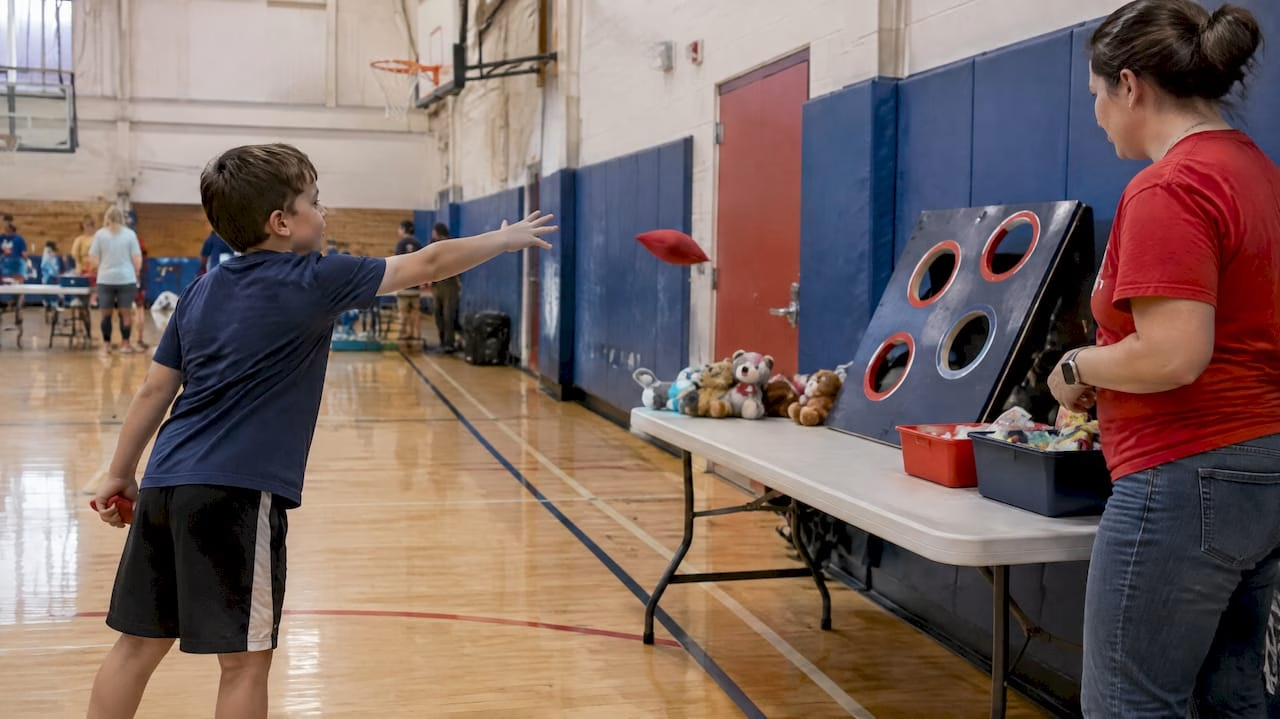
Schools in Kitchener, Kingston and elsewhere in Ontario run the same format at very different scales: a free-admission evening of two and a half hours, or a four-hour Saturday with ticket sales. Neither is better. What matters is that the event fits the volunteers you really have.
The event is also a community moment. Parents who never meet at drop-off stand in the same line, kids from different grades play together, and local businesses see the school as a neighbour. Planning for that, with shade, seating, a clear entrance and something that makes people linger, matters as much as the game list.
Step 1: Get approvals before you announce anything
In Ontario, fundraising at a school is not something a parent group decides alone. The Ministry of Education’s fundraising guideline draft says fundraising must be permitted under board policy, approved by the principal and supported by the school council or school fundraising organization. It also says proceeds and donations should be reported transparently to the school community. The Toronto District School Board likewise says all school-related fundraising must be approved by the principal.
In practice:
- Take a one-page proposal to the principal: date, hours, location, expected attendance, the goal for the money and who is responsible.
- Confirm your board’s rules on community use of the building and grounds, especially for evenings and weekends.
- Agree who will report the results to families afterward, and what format they will use.
Doing this first protects you. A date you announce before approval is a date you may have to retract.
Step 2: Build the timeline
The Ottawa-Carleton District School Board tip sheet says planning should start 16 to 20 weeks ahead. In that window you appoint an event chair, recruit volunteers, and set the theme, program, budget, date, time and location. You also check audience, rain date, parking, accessibility, capacity, duration, donations and permits. An Alberta guide for fundraising societies suggests settling the date and venue at least three months ahead.
A workable Ontario calendar for a June funfair looks like this:
| When | What gets done |
|---|---|
| Late winter | Principal approval, event chair named, date and rain date chosen |
| Early spring | Committees formed, budget drafted, insurance and permit requests filed |
| Six to eight weeks out | Food plan confirmed, vendors and entertainment booked, donations requested |
| Two to four weeks out | Volunteer schedule, maps and name tags, tickets and promotion |
| Final week | Weather decision, volunteer reminders, walkthrough of the grounds |
| After the event | Clean-up, cash reconciliation, report to the school community |
Spring dates fill quickly because every school wants the same few weekends. Booking popular vendors early is the simplest way to avoid a compromise on your date.
Step 3: Set the budget and decide how you will raise money
The fundraising-societies guide lists the usual revenue sources: donations, ticket sales, sponsorships, auctions and raffles. It also lists costs to budget for: promotion, insurance, décor, food and supplies, office expenses, venue, portable toilets and tents. After the event you compare revenue with costs to see whether you made a profit or a loss.
A few habits keep a budget honest:
- List every cost, even the ones the school covers. If the school donates custodial time, record it so next year’s committee knows what the event really needs.
- Add a buffer. One school event checklist recommends a 15% budget buffer, and that matches what most committees learn the hard way.
- Order prizes generously. PTO Today advises ordering enough prizes for every child to win at each game, plus at least 20% extra.
- Use the two-person rule for cash. The same event checklist recommends two people whenever cash is counted or deposited.
Ticket-based games are the classic engine, but food is where families spend without thinking about it. A treat that is easy to buy, comes in many sizes and suits many diets sells itself, and you can set up the ticket or cash handling to match your school’s routine.
Step 4: Insurance, permits and food rules
This is the part that surprises first-time organizers, so read it before you commit to a venue or menu.
Insurance and community-use permits
If the event runs outside regular school operations, your board may treat it as a community-use booking. The Grand Erie District School Board handbook requires a community-use permit for applicable events and proof of liability insurance of at least $2,000,000 per occurrence, naming the board as additional insured, or coverage purchased through the permit process. The Toronto District School Board states that insurance is mandatory for every permit, with the same $2,000,000 minimum and the board named as additional insured. Requirements differ by board, so ask your own board’s community-use office for its current terms.
The Alberta fundraising guide adds that after-hours school use may involve a facility-rental booking, insurance and custodial fees. Ontario boards may bill similar items, so ask what applies.
Food: when public health needs to know
In Ontario, a school that serves food to the community is treated as a food premise. The Simcoe Muskoka District Health Unit explains that schools must comply with the Ontario Food Premises Regulation (O. Reg. 493/17), and that a special event serving food to the community is a temporary food premise.
Municipalities lay out the practical side. Oakville’s special events guide requires organizers offering any food, including samples, giveaways and volunteer-prepared food, to notify and get approval from Halton Region Public Health, and food vendors need municipal licensing and public-health approval. Scugog’s special event planning guide says food offered for sale or free needs Durham Region Health Department approval, and food vendors must apply at least 30 days before the event.
If your funfair includes midway-style rides or amusement devices, check your municipal rules too. Waterloo’s business licensing bylaw asks for owner permission, a list of exhibits, games and stalls, and recent Technical Standards and Safety Authority approval for amusement devices, and fairs selling food also need health approval.
The takeaway: contact your public health unit and your municipality early, tell them exactly what food you plan to serve, and keep the approvals on file. Public health approval is a step the authority owns; it is part of the process, not a hurdle to avoid. When you book a truck for your event, our team can walk you through what we need from your side so the food plan lines up with your venue’s rules.
Step 5: Plan food and refreshments
Food decides how long families stay. Most funfairs run some mix of barbecue, bake sale, snacks and drinks, all of which need volunteers, coolers, hand-washing, power and cleanup. That is a lot of labour for a few hours, and it pulls your most reliable parents away from the games.
Two things help. First, build the menu around what suits the largest number of kids and families, including allergies and dietary needs, and label everything clearly. Second, think about where the lines will form. A single food table creates a bottleneck. A separate, self-contained treat station spreads the crowd across the grounds.
If your committee is also weighing a hands-on kids’ food activity, a guide to kids cooking party menus and safety tips has useful menu planning ideas you can adapt for a classroom-style station.
For the treat station, an ice cream truck is hard to beat. Our menu covers soft-serve ice cream, sundaes, floats, milkshakes, popsicles and banana boats, with customizable toppings that include organic and kosher options. That range means a kindergartner, a Grade 8 student and a parent with a dietary requirement can each find something. If you want to see how schools use it, our page on school fundraiser ice cream truck ideas goes through formats that fit a funfair.
Step 6: Choose activities by age group
PTO Today lists musical cakes, ring toss and fishing games as standard carnival fare, with pony rides, face painting, hayrides, amusement rides, student or local-band performances, bake-offs and chili cook-offs as extras. It also advises testing unfamiliar games with children before the day.
Use that as a menu, then match it to the ages in your school:
- Kindergarten to Grade 2: simple games with a guaranteed prize, face painting, a bubble or sensory zone, a quiet corner for tired little ones.
- Grades 3 to 5: ring toss, fishing games, cake walk, relay-style games and inflatables with clear height rules.
- Grades 6 to 8: student performances, bake-off competitions, a photo booth, sports challenges they can run for younger kids.
- Families and adults: a silent auction, a vendor market, a raffle, seating in the shade and a good coffee or cold treat.
An age-balanced mix keeps older students from drifting away and gives parents a reason to stay. Student volunteers running a game for younger kids often become the highlight for both groups.
Step 7: Volunteers and event-day logistics
The Ottawa-Carleton tip sheet recommends appointing an event chair and committees, estimating attendance and refreshments, arranging parking, accessible access and restrooms, preparing first aid and emergency supplies, making volunteer maps and name tags, booking equipment, and organizing set-up and clean-up. Break that into committees that each have one owner:
- Games and prizes: tests games, counts prizes, staffs stations.
- Food and treats: liaises with public health, vendors and the food team.
- Money and tickets: runs sales, the float and the two-person count.
- Site and safety: parking, signage, first aid, restrooms, rain plan.
- Communications: flyers, school newsletter, social posts, thank-you notes.
The event-planning checklist from SchoolRelay recommends written venue permission, final volunteer reminders with parking and check-in details, a weather or rain-date decision, and a walkthrough to find trip hazards and broken outlets. Do that walkthrough the day before, not the morning of.
Step 8: Make it safe and accessible
The Ottawa-Carleton tip sheet asks organizers to check seating, parking and accessibility for people with disabilities and to provide restrooms, a first-aid kit, a fire extinguisher, a phone and emergency numbers. The same event checklist from SchoolRelay recommends a clearly marked first-aid station and a missing-child protocol that every volunteer knows.
For accessibility, the City of Vancouver’s accessible events checklist is a useful model even for Ontario schools. It asks organizers to consider mobility, sensory, communication and chemical-sensitivity needs, and to plan for assistance dogs, walkers, wheelchairs, scooters and strollers. It also says emergency evacuation procedures should include people with disabilities and seniors. On timing, it recommends planning at least four weeks ahead, noting that HandyDART users need at least a week’s notice, ASL assistance generally two weeks and Braille transcription four weeks.
Small choices make a big difference: firm, level paths between stations, a quiet area away from music, space for strollers at the treat line, and clear signs. Add an allergen note to your food signage so families can decide quickly.
Why a truck solves more than the dessert problem
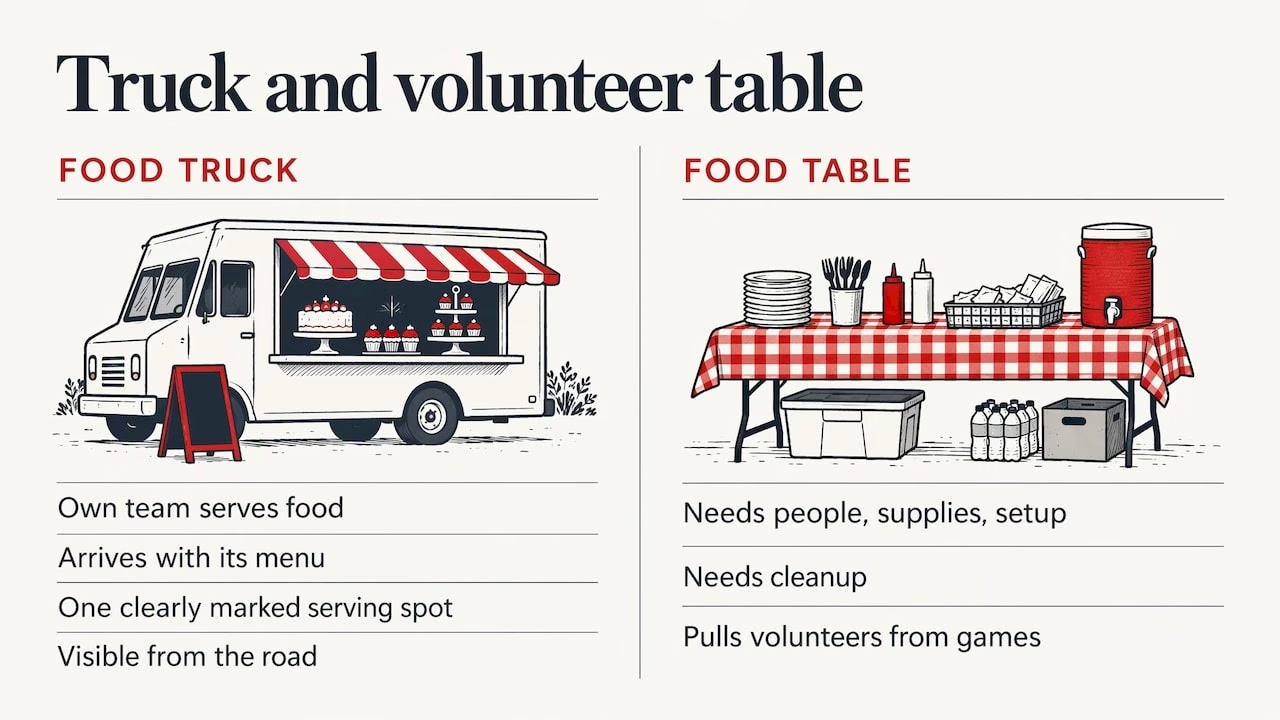
Most funfair committees do not lack ideas; they lack hands. Every table you run yourself needs people, supplies, setup and cleanup. A rented truck is a self-contained food service that arrives with its menu and its own team, so the line forms at one clearly marked spot instead of pulling on your volunteers.
It also does something no table does: it announces the event. A truck parked at the edge of the field is visible from the road, photographs well for your newsletter, and gives older students and parents a reason to come along. For schools that want to go further, we offer branded truck rentals in Ontario, which suits a school or sponsor that wants its name on the experience.
Our view from the truck window
We are a family-owned business, and school events are some of our favourite days. A funfair works when kids and parents spend the afternoon together, not in a line for something that took three volunteers an hour to set up. That is why we built our menu around variety: soft-serve, sundaes, floats, milkshakes, popsicles and banana boats, with customizable toppings including organic and kosher options.
Our approach is to treat a school event as a community moment. We customize rental packages to fit your event’s size and needs, and we aim to make each booking feel like part of the celebration, not a vendor in the corner.
If you are choosing one attraction to anchor your funfair, we think a truck delivers the most for the least volunteer effort: one stop, a wide menu, and a memory the kids carry home.
the author
Book the truck for your funfair
If you are planning a school funfair or fundraiser in Ontario, our team can help you build a package for your date, crowd and menu. Start with our fundraiser ice cream truck page, or see everything we offer on our Ontario rentals page. We have no published price for rentals, so tell us your date, location and expected attendance and we will go from there.

Book early. Spring weekends are the most requested dates for school events, and your public health notice and community-use permit both work better when your food plan is already confirmed.
A final pre-event checklist
Print this and hand it to the chair a week out:
- Principal approval in writing, and the school council on board
- Community-use permit and insurance certificate on file, if your board requires them
- Public health notice or approval for all food, sold or free
- Rain date or indoor plan announced to families
- Volunteer schedule, maps and name tags printed
- First-aid station, extinguisher, phone and emergency numbers in place
- Missing-child protocol shared with every volunteer
- Two-person cash count arranged and a float ready
- Accessible paths, seating and restrooms checked
- Prizes counted with a 20% cushion
- Food and treat station location marked, with signage for allergens
FAQ
How far ahead should we plan a school funfair?
Start 16 to 20 weeks ahead, which is the window the Ottawa-Carleton school council tip sheet uses. That gives you time for principal approval, permits, insurance, vendor bookings and volunteer recruitment. If you want food approvals and a truck booking on your preferred weekend, start even earlier.
Do we need insurance for a school funfair in Ontario?
If your event is held under a community-use permit, boards such as the TDSB and Grand Erie require liability coverage of at least $2,000,000 per occurrence with the board named as additional insured. Rules vary by board and by whether the event falls under regular school operations, so confirm with your board’s community-use office.
Do we need public health approval to serve food?
Often, yes. Ontario municipalities such as Oakville and Scugog ask organizers to notify or get approval from the regional health unit for any food offered, including free food, and vendors usually need to apply at least 30 days ahead in some areas. Check with your local health unit and municipality as soon as your menu is drafted.
How do we raise money at a funfair?
Common sources are ticket sales, donations, sponsorships, auctions, raffles and food sales. Budget for insurance, venue, tents, toilets, food and supplies, and compare revenue with costs afterward. Report the results to your school community so families see where their money went.
Sources
- Today’s Parent example of a Canadian school fundraiser
- PTO Today school carnival planning guide
- Guide for fundraising societies
- Ontario Ministry of Education fundraising guideline draft
- Toronto District School Board fundraising types
- Ottawa-Carleton District School Board school council tip sheet
- SchoolRelay school event planning checklist
- Grand Erie community use of schools handbook
- TDSB community use of schools
- Simcoe Muskoka District Health Unit food safety in schools
- Oakville special events user guide
- Scugog special event planning guide
- City of Waterloo business licensing bylaw
- City of Vancouver accessible events checklist
- Kids cooking party ideas, menus and safety tips